We read more than 1,000 public records about data center construction delivery. Regulator actions, court filings, mechanic's liens, project announcements, practitioner interviews, and builders' own published case studies, collected through structured searches and then targeted passes through litigation records.
One pattern held across otherwise unrelated cases. Delivery risk rises when a commitment depends on a state that the next responsible party hasn't confirmed: a permit, a design freeze, a crew, an acceptance.
Construction failure rarely gets documented while it happens. It gets documented afterward, in claims, because by the time the truth about a change surfaces, the only place left to reconcile it is a courtroom.
Almost none of these reached a merits ruling. They settled, or they are pending. That is the point. The dispute is the cost, and every dollar above was spent arguing about what was true, when, and who knew it.
Two of the six failure surfaces we mapped sit upstream of the builder. A township halted soil work on a data center site pending review, while the fencing, trailer, and signage permits stayed valid. The stop had a precise scope, and work committed against the wrong reading of it would have paid for the difference. Owners also change their minds. Microsoft paused part of a Wisconsin campus for a design and technology review while the first phase kept building. A builder doesn't control those states. Its commitments consume them anyway.
The other four surfaces belong to delivery, and the evidence there is specific.
Buying before design is done. IREN disclosed ordering major transformers and breakers while its high-voltage design was still moving. That is not a failure. Everyone does it, because the factory queue won't wait for a finished drawing set. It is an exposure that someone has to own, bound, and re-check every time the design moves. The teams that govern it explicitly, with staged releases and temporary equipment decisions under named authority, are the ones whose stories end well.
Field truth. The most complete failure chain in the public record belongs to a fiber contractor at a major data hub. Continuous granite drove production to 8-12 feet per day against a ten-month commitment, and a sustained miss threatened roughly 20% of contract value. The team measured the variance against explicit thresholds, changed drills, crews, and tooling, and finished in eight months. The lesson isn't that rock is hard. It's that they saw the gap between plan and ground early enough for the recovery to be a decision instead of a scramble.
People and capacity. In DPR's own retrospective of a live-facility renovation, a major equipment change eleven weeks before a fixed turnover met an unchanged date, and three-shift working exhausted the local electrician supply. The recovery worked because scope was delegated deliberately. Capacity on paper, a signed sub or a workforce total, is not a crew in a specific building in a specific week. Even the reviewers are capacity. One Illinois town, facing almost 300 inspections for a single building, raised fees and bought 516 hours of outside high-voltage review.
"Done" isn't done. One operator's financial reporting traces the real chain. A hall is delivered in April, rent commences in Q2, capacity reaches the customer later still. Delivered, energized, commissioned, accepted, paying: five different days, owned by different people. At another campus, temporary generation was installed for commissioning while permits were still open. Installed and authorized are different states too.
The sophisticated end of this industry is not waiting to be saved. Builders have standardized safety across gigawatts of work, moved duct banks and electrical rooms into factories, mandated shared planning boards across their trade partners, and built portfolio dashboards their executives actually use. We read their accounts closely and they are impressive.
What's striking is what stays manual in their own telling. In one of the country's most advanced delivery-technology programs, the published account notes that schedule updates still had to be re-entered by a planner daily while the integration to automate it was still being built.
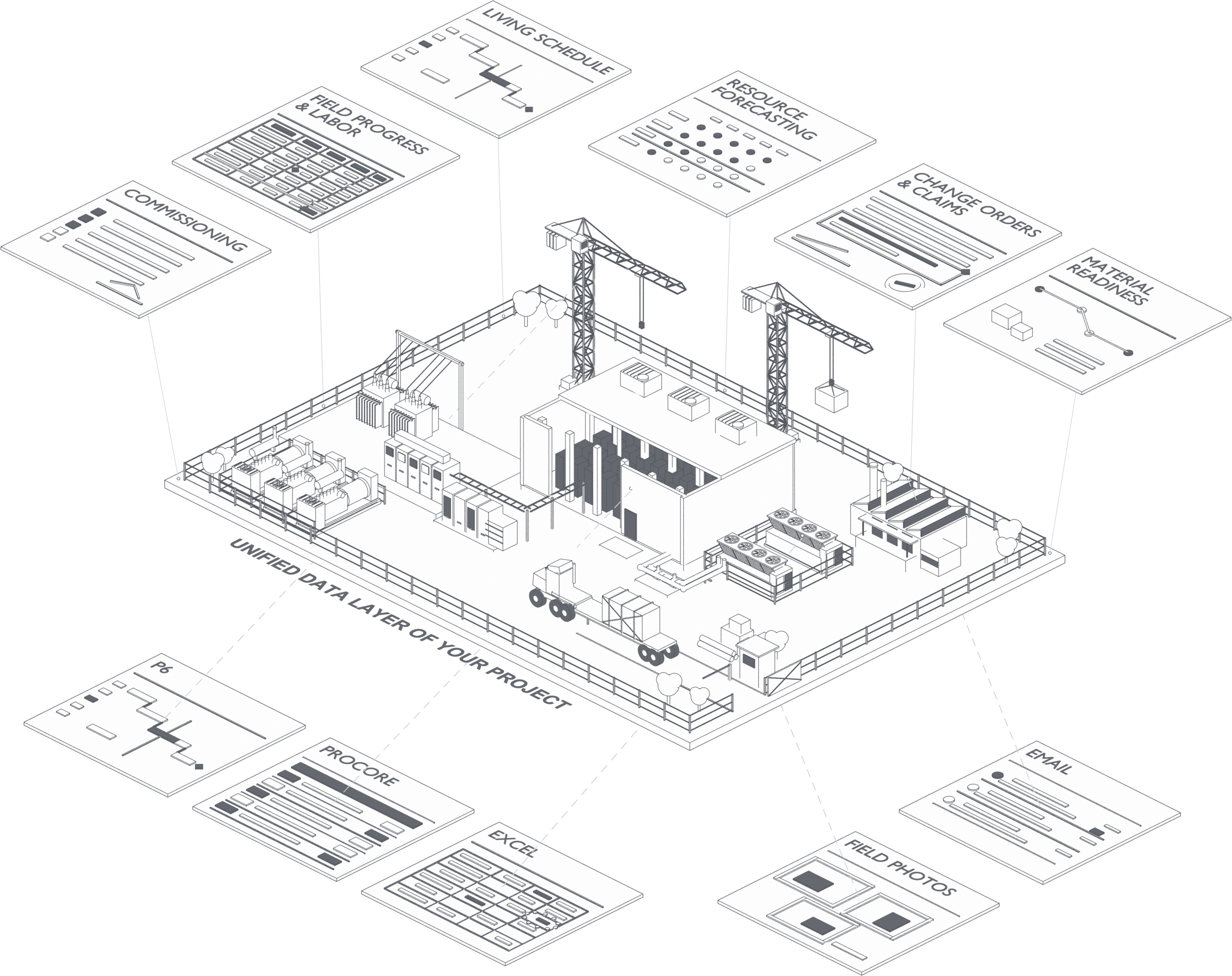
That is the shape of the gap. These systems hold status, and they hold it well. A dashboard can tell you where every package stands this morning. What none of them answers is the next question: this drawing changed yesterday, so which purchase orders, which crew bookings, which test dates were built on the old version? That walk still happens in someone's head, in a meeting, or not at all. It is the most expensive manual process left on a modern data center job, and it is the one nobody has automated.
So the question a delivery team should be able to answer on any morning is a narrow one. Which commitment on the job today depends on a state that nobody has confirmed this week? A permit, a drawing revision, a crew, a test, a signature. Our previous post describes what it takes to answer that continuously instead of at the next update.
