CONTINUOUS PROJECT CONTROLS FOR MISSION-CRITICAL GENERAL CONTRACTORS
Your project changes every day. Your controls catch up later.
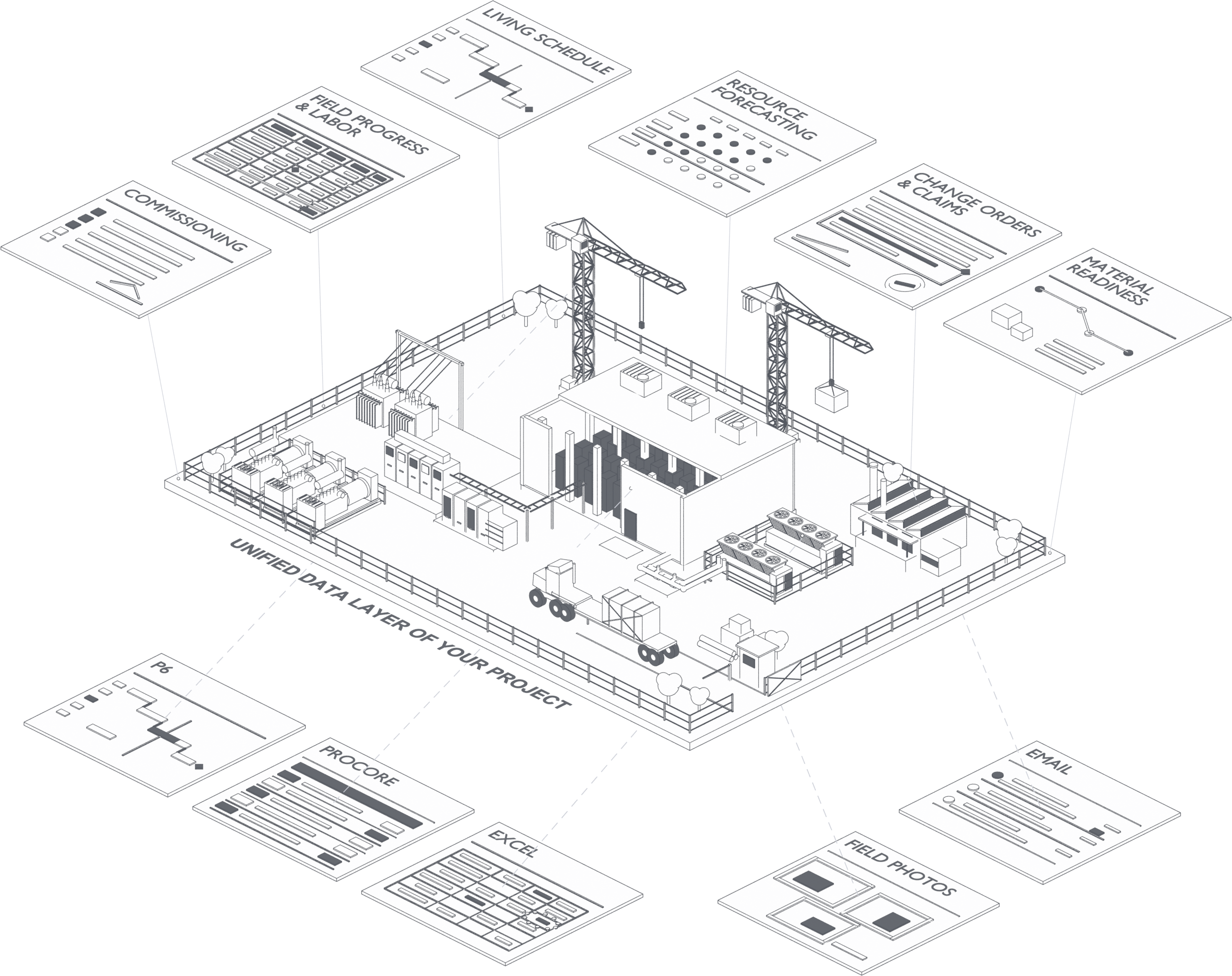
Your schedule, procurement log, vendor emails, field updates, cost data, and commissioning records all describe the same project, but they rarely change together.
Terminal Use keeps them aligned as work happens, so your team catches missing material, late approvals, unsupported progress, and cost drift while there is still time to act.
Your scheduler updates the plan. Procurement tracks required-on-job dates somewhere else. Vendor commitments live in email.
Warehouse receipts arrive as PDFs and packing lists. Field labor gets coded later. Budget gets reconciled on another cadence.
Each system can be right on its own, and the project can still be wrong.
Terminal Use connects those handoffs so a change in one place can be understood everywhere it matters.
Where those handoffs sit is different on every project. So is every Terminal Use build.
The schedule says the equipment will be ready. The evidence says otherwise.
The P6 activity may still show the planned installation date. But the submittal slipped. The vendor moved the factory test. Part of the PO hasn't reached the warehouse. The electrical room isn't ready. And none of those facts have reached the current schedule update yet.
Terminal Use connects that evidence to the activities and milestones it affects, so the team can see the mismatch before crews are waiting and the critical path has already moved.
Terminal Use reads the plan and the evidence around it: P6 updates, procurement commitments, vendor communication, RFIs, submittals, field reports, warehouse receipts, and commissioning records.
02
RECONCILE IT AGAINST THE PROJECT
Terminal Use connects new evidence to the activity, required-on-job date, cost code, dependency, or turnover milestone it affects, so the team can see where reported state and actual project evidence have started to diverge.
03
ACT WHILE THERE ARE STILL OPTIONS
Terminal Use shows what changed, why it matters downstream, the evidence behind it, and what to resolve next. Instead of discovering the problem in the next reporting cycle, you investigate it while recovery is still possible.
Catch the problems that usually surface too late.
MATERIAL READINESS
The required-on-job date moved. Did procurement move with it?
Connect takeoffs, approvals, POs, vendor commitments, warehouse receipts, shipping, and P6 dates so the team knows whether the right material will actually be on site when the schedule needs it.
Don't discover the material list is wrong when the foreman is ready to install it.
FIELD PROGRESS & LABOR
Don't discover a productivity problem after the whole scope is finished.
Connect reported progress with the labor actually being spent so project teams can compare planned versus actual performance while repeatable work is still underway.
Catch the problem on the first building, not the twelfth.
MILESTONE READINESS
Equipment on site doesn't mean the milestone is ready.
Connect schedule activities with submittals, RFIs, room readiness, controls, OEM support, inspections, startup, and test evidence.
See which prerequisite is weakening the milestone before it becomes a turnover problem.
Built for trust.
Terminal Use doesn't ask your team to trust a black-box risk score. For every consequential schedule claim, it shows what the plan says, what the latest project evidence says, and where that evidence came from.
SupportedCurrent evidence supports the reported date or progress
At riskA prerequisite, commitment, or assumption is weakening
ContradictedCurrent project evidence conflicts with the schedule update
Needs evidenceThere isn't enough recent evidence to trust the reported state yet
Don't replace P6. Don't give your people another system to maintain.
Your teams already have software. The problem is the manual work required to keep all of it consistent.
Terminal Use works across the systems and communication your project already produces: schedules, spreadsheets, email, reports, procurement records, warehouse data, and field evidence.
There is no standard deployment. Every build is shaped to the project: its schedule, its systems, its data, and the way the team actually runs the job.
01Start with the existing process.
02Automate the reconciliation first.
03Change the workflow only where it actually improves the project.
Bring us one project you want to transform.
Show us the schedule, the systems around it, and how your team currently tracks readiness. We'll walk through where the control loop breaks today and what Terminal Use should connect first.